Bridging Roots - Preserving Samoan History, Language, and Oratory Workshop
Introduction: A Workshop on Academic Resources for Preserving Samoan Family History
This essay documents the January 10, 2026 session of the Intro to Samoan Genealogy Workshop Series, focusing on methods, sources, and lived research practices that contribute to preserving Samoan family history, language, and cultural knowledge. I attended and documented this session as part of my role in organizing and reporting on the Intro to Samoan Genealogy Workshop Series. My perspective reflects both direct observation of the session and my broader work in documenting Samoan genealogical knowledge for diaspora communities.
The speakers were Loau Tuiloma Dr. Manumaua Luafata Simanu-Klutz, Shoshana (Susan) Hannemann, and Fepulea’i Lāsei Dr. John Mayer. John Mayer gave an overview of methods, resources, and processes relevant to researching Samoan family history. Then, two scholars—Manumaua Luafata Simanu-Klutz and Shoshana Hannemann—presented research reflecting a deep engagement with Samoan history, language, and family narratives.
John, Fata, and Susan expressed willingness to continue contributing to endeavors preserving and sharing Samoan culture.
Methods and Resources for Samoan Genealogical Research
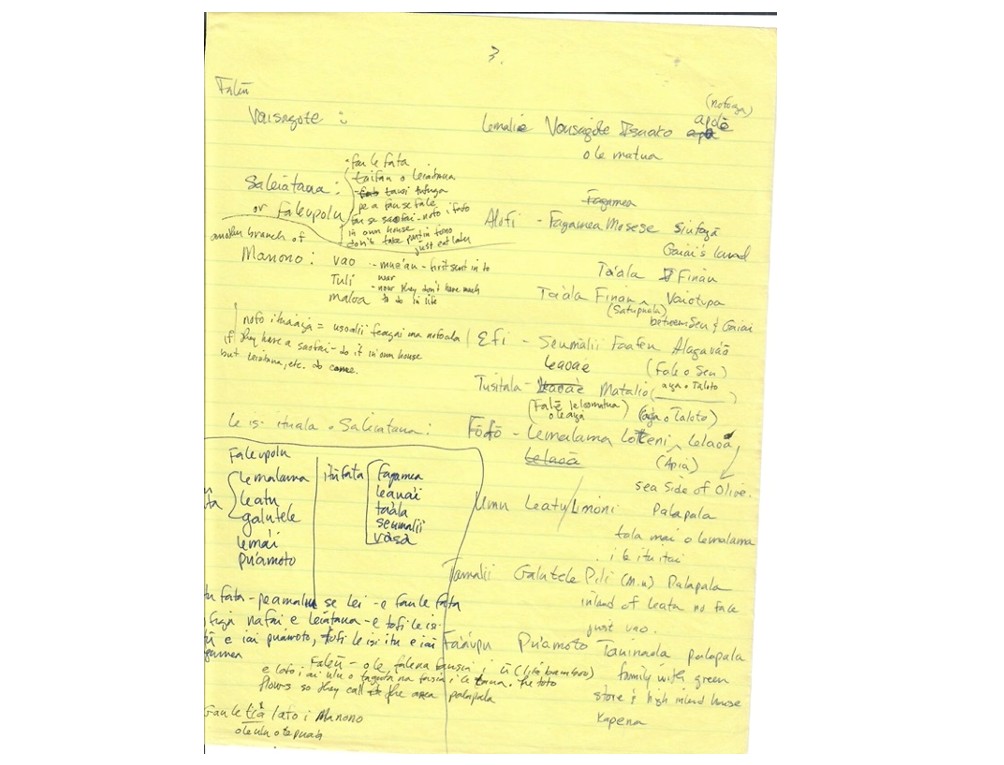
Fepulea’i Lāsei Dr. John Mayer is an Associate Professor of Samoan and Director of the Samoan Program at the Department of Indo-Pacific Languages and Literatures at the University of Hawaii at Manoa. Following six years with the United States Peace Corps in Samoa, John established the Samoan Language and Literature Program at the University of Hawaii in 1976. His current research interests include language change in Samoan heritage language communities, code switching, and second language teaching. John received his title in 1984. To understand what the title meant and where it came from, he had spent several years researching genealogies in Faleū and Lepuia'i villages on the island of Manono.
He grouped methods, resources, and processes for researching Samoan family history into three categories: texts on Samoan history and genealogy; internet sources; and data collection.
John highlighted Augustin Kramer's book “The Samoa Islands,” originally published in German around 1900, as a key historical academic resource for Samoan genealogical research. “Volume one, which contains all of the genealogies of all of the villages in Samoa and history of Samoa and history of particular villages and titles.”
Regarding other books on Samoan history, language, and genealogy, John noted that although a lot has been published, “Most of it goes out of print very quickly, so the only place you might find some of these really important books are through university libraries or maybe through family members who have copies.” Most early texts were published by non-Samoans; many new texts now are being published in Samoan and English by Samoan authors, Samoan chiefs, Samoan historians, and Samoan educators.
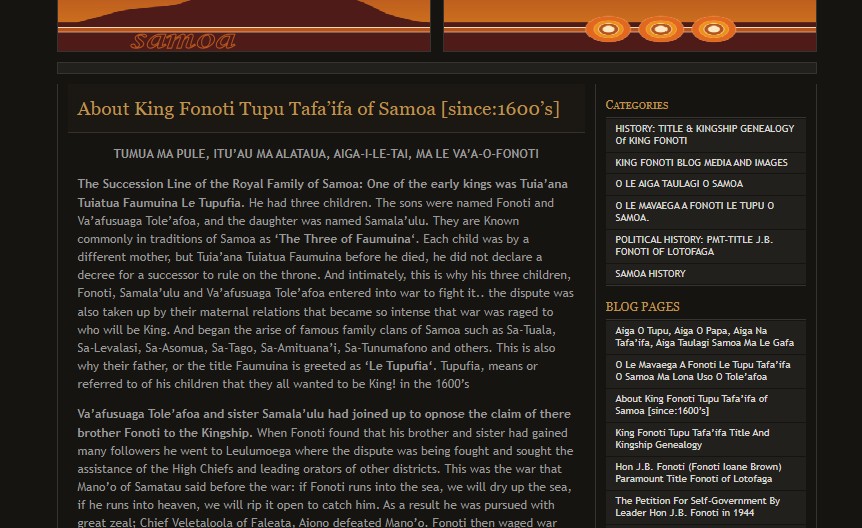
John encouraged the use of social media and online platforms to share and collaborate on genealogical research: “Go online and google names of family members, names of titles. You'll be surprised how much you can connect with people already doing research. You can also create a site where people can contribute and talk and discuss things with you.”
Regarding data collection, John emphasized having interviews with relatives, especially the older people, as the most important component of researching Samoan family history. He highly recommended recording, with consent; emphasizing that recording interviews creates a permanent archive and allows researchers to revisit details that may initially be missed. As part of data collection, John encouraged sketching a diagram and then writing up a story to share with others in the family.
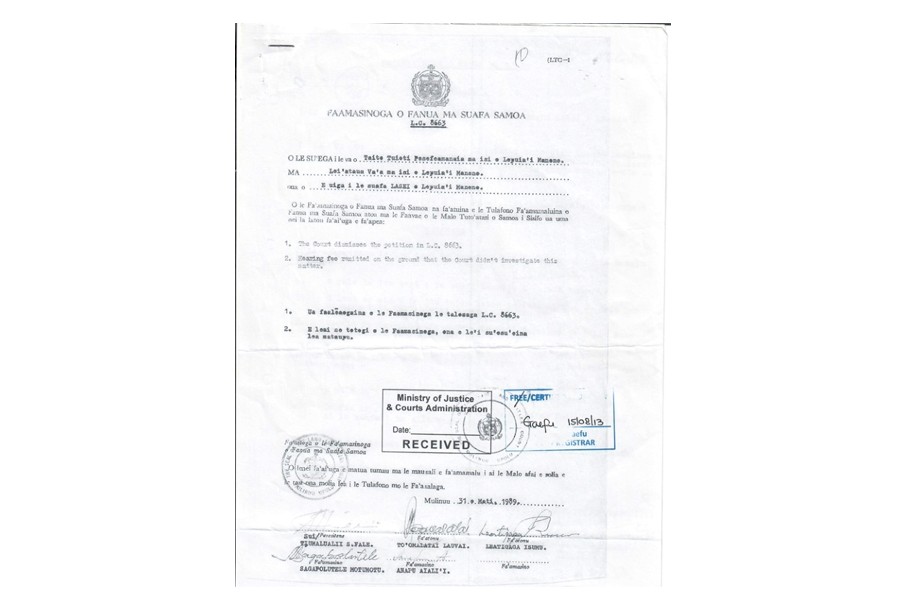
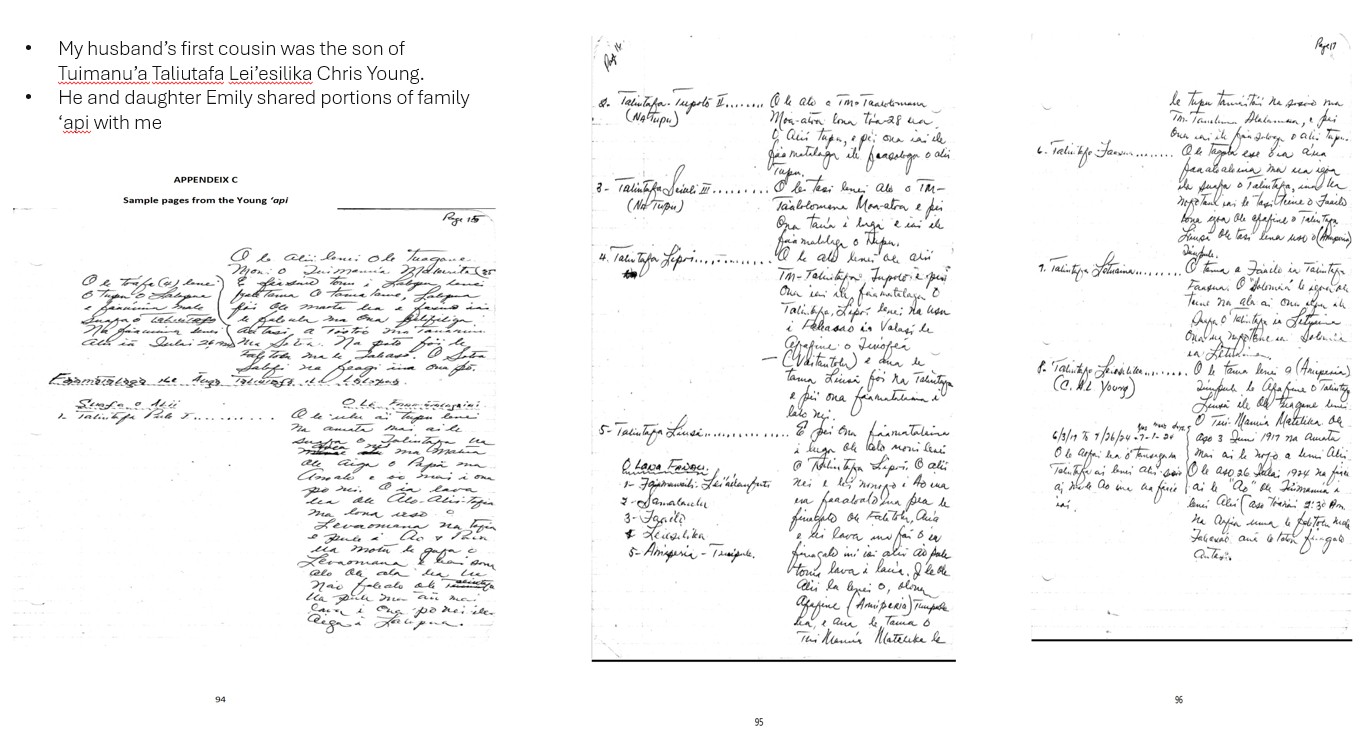
Families may have their own documentation of family history to share. To mediate disputes over land and titles, Germans and the Americans established the Land and Titles Courts. The legal system that was introduced requires written documentation of claims to titles or land. Every family began keeping a written version of their own family history and titles called the family notebook, or ‘api. “It’s difficult to get the actual court records, but most families have gone through this process and may have kept copies of their testimony and of the decision from the court.”
His closing recommendation: “I would suggest that you create a website and share what you found, check your stories with relatives and revise with new insights and information that you get with this collaboration with other people.”
Lived Experience as Historical Method: Fata’s First Research Journey
Loau Tuiloma Dr. Manumaua Luafata Simanu-Klutz (Fata) is a retired associate professor and scholar in Pacific and Samoan studies from the University of Hawaii-Manoa, recognized for advancing language, history, and culture in Hawai‘i.
Her publications include “Ancestral Ethics and Samoanness” in Our Voices, Our Histories (2020), co-editing and contributing to the anthology, Voices of Social Justice and Diversity in a Hawai‘i Context (2019), and a special issue of the UCLA Amerasia Journal’s on Pacific languages in diaspora (2017), as well as translations, poetry, and policy briefs focused on Samoan identity, education, and social justice.
Fata spoke about her personal experience with researching family history and genealogies that are very personal to her: her master’s thesis “‘Aumua Mata’itusi Simanu: Lifestory of a Samoan Educator and Orator in Diaspora” (2001) relates the story of her mother, a Samoan educator in the diaspora. Her PhD dissertation, “‘Ā Malu i Fale, ‘E Malu Fo’i i Fafo,’ Samoan Women and Power: Towards a Historiography of Changes and Continuities in Power Relations in Le Nu’u o Teine of Sāoluafata” (2011) describes the history of the village to which she traces her ancestry. Her writings demonstrate that family history is inseparable from questions of identity, language, and social change. Through this lens, documenting a life story becomes an act of preserving history—not only for a family, but for a wider community.
Fata's personal journey in researching family history began with returning to school to research their mother's life and the village of Sāoluafata. “I was in my early 50s when I decided to return to school. I was very curious about things after being with my mother for a decade as she was teaching with John at the university, teaching Samoan respect language, fa'alupega, and ceremonial speech, lāuga. I thought I knew all I needed to know about our Samoan language and culture. But through my experience with my own mother, I realized that I really hadn't scratched much of the surface where Samoan knowledge was concerned.”
Fata reflected, “History was once understood as the past written down. People who did not have a written language, who used oral tradition to pass knowledge from one generation to the next, were considered to be people without history. After World War II, with the return of colonies to their native owners, the post-colonial era made possible the inclusion of ‘other’ voices.“
The chair of the master's program at the Center for Pacific Island Studies advised Fata to write the story of her mother, Aumua Mata’itusi Simanu, who played a key role in the history of education and also the evolution of women's power in the Samoan system. “The research was one person deep and 82 years long. From that story, I saw patterns of the history of women in education, in the church; as mothers, as wives, as daughters, and so forth.” Aumua became the first woman principal and the first woman school inspector; she blazed the trail for a lot of women to come through these leadership positions. Fata’s thesis based on her mother Aumua’s life story also became a model for students coming later: “You can challenge the system and say, ‘Okay, that's the traditional method. This is how Samoan people tell their stories.’”
Reframing History: Orality, Writing, and Authority
Fata affirmed that Samoa’s orality is no longer enough to maintain customs and traditions. “We’ve been writing since the missionaries introduced writing to Samoa. Writing is now a Samoan tradition. We have to write, both in English and Samoan. This is how I see our language and our culture surviving into the centuries going forward.”
She urged caution against getting stuck in the idea that only Samoans can tell Samoan stories. “We have to form teams with other people, whether they're Samoan or not. Kramer, for example, has been my go to book to research my PhD, because he had the heart to realize that Samoa was losing a lot of its traditions because of the incoming forces during colonialism, such as government and church.”There are not enough Samoan sources in the archives. Samoans need to tell our stories, but other witnesses to history also have the right to tell our stories.”
Fata’s call to action for beginners: “Start with your own family, tell your story. If you have people objecting to what you’re writing, do the disclaimer: ‘E tala lasi Samoa (Samoa has multiple versions of the same story);’ that is your story.”
Fata listed some resources she used learning to do history at the University of Hawaii:
Pacific Islander historians (list from UH Manoa)
Bettie Ickes (retired)—19th–20th Olohenga, Tokelau
Brian Alofaituli—religion (National University of Samoa)
Keith Camacho, a Chamorro from Guam—US militarization of the Pacific (UCLA Asian Studies)
Julian Anesi—disability studies (UCLA Women’s Studies)
Shoshanna Hanneman
Fata Simanu
John Mayer (not the singer)
Fata Ariu Levi—author of a series, Navigators Quest for a Kingdom in Polynesia
Pioneers in the development and growth of a Pacific literature
Albert Wendt
Sia Figiel
Porotesano Malifa
“There are more and more Samoans now doing research about any topic, but there's still not enough history, looking at the past. So I hope all of you who are listening will become part of that pool, and that the fact that you're there is an indication that you are committed to really moving forward, regardless of where you were born or raised.”
Case Study: Sāoluafata and Women’s Power
Sāoluafata, on the northeastern side of the island of Upolu, is the only village in Samoa that was founded by women. Fata’s PhD dissertation tells how the village started, relating what sources are used. As more and more palagi came into Sāoluafata bay: “The girls realized that because of certain taboos, they needed the men to go face the other men. So the power was then shared with the men, but the men know that when the women speak, they need to listen.” Fata explained: “A lot of issues emerged during that research, but the joy for me is, this history goes back to the 1300s, then I trace it down to 1998 when my own Auntie died, who was one of the leaders of the villages. I have shared it with our Sa’o (ranking family chief); he promised my mother that he will make sure that the village, the nu'uoteine, will not disappear. Samoan now is caught up in the development mode, and a lot of the people there do not know their past; a lot of our youth do not know that. So, we need historians.”
Fata noted: “Going into research in Samoan sphere, I would recommend you learn that language. It's a must, because knowing that language also gives you the depth and nuances of that information that will help you interpret that past.”
She further recommended that researchers be mindful that traditional research tools such as paper questionnaires and recording devices can intimidate some people. She reminded aspiring researchers to always respect boundaries, for instance if recording is refused. To reach a wider and more responsive sample, Fata encouraged using modern communication technology like email, texting, or messaging apps. In her experience, people were even more generous with their time on these platforms, and they were absolutely essential to the success of her own research.
Archival Gaps and Genealogical Reconstruction: Susan’s Research
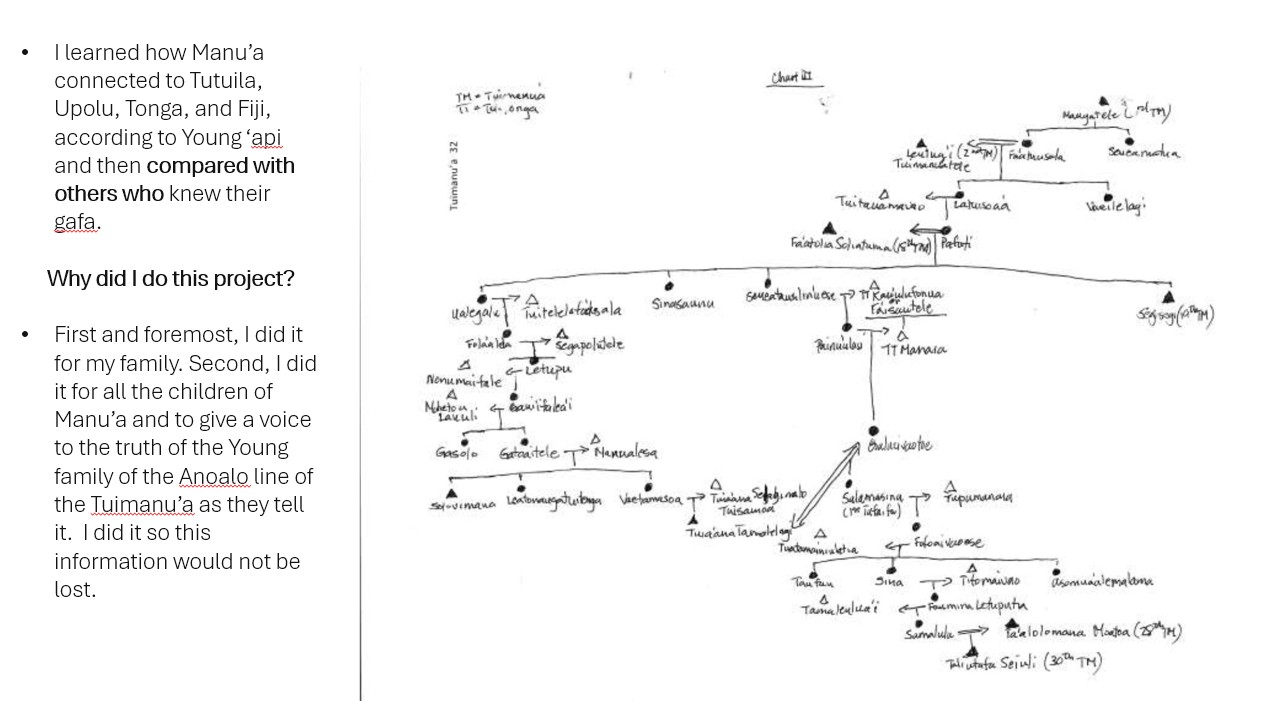
Shoshana (Susan) Hannemann is semi-retired after working in the non-profit sector as an educator, lobbyist, and office manager for a non-profit religious organization. Like Fata, she went back to school as a non-traditional student in her 40s. She received her BA in Hawaiian Pacific Studies from UH West Oahu in 2010 and her MA in Pacific Island Studies from UH Manoa in 2013. She did research in American Samoa in 2011 and continues to work with her Samoan family, helping to compile the stories of the descendants of the Young family of the Anoalo line of the Tuimanu'a from creation until present. The family awarded her the honorific title Lefanoga.
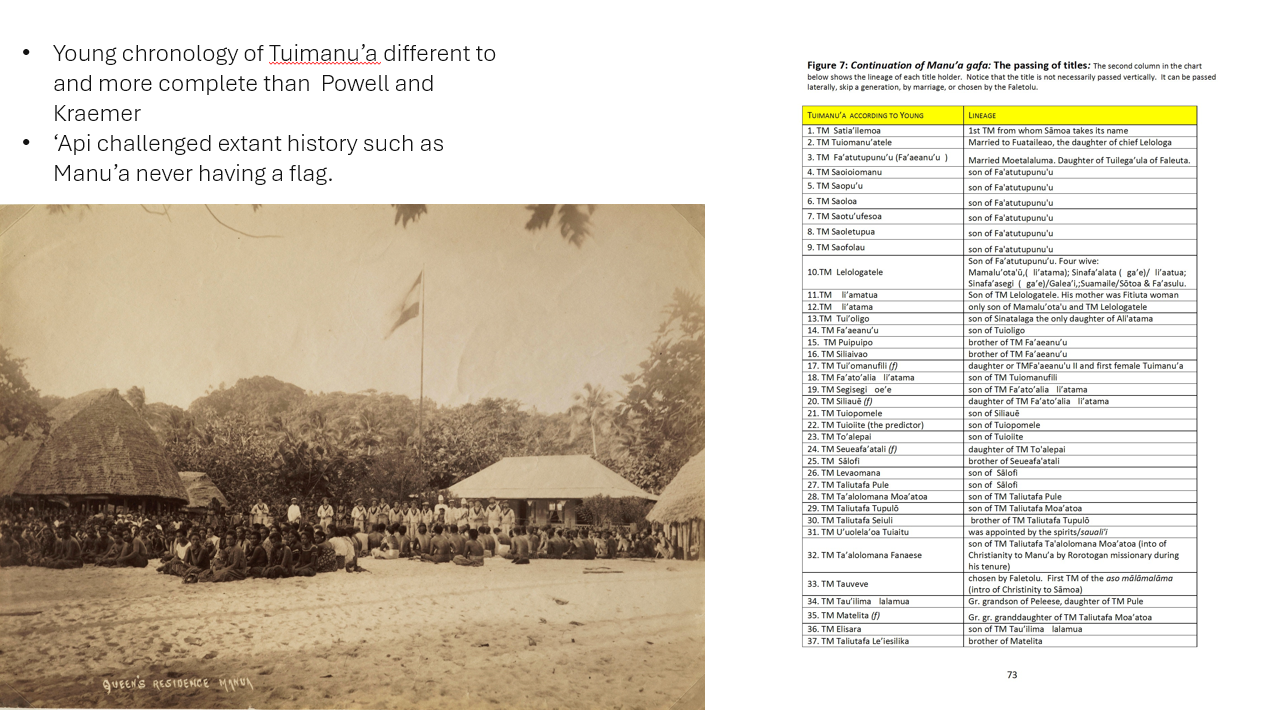
Susan discussed her work accessing historical records of the Young family of Manua. Following Fata, she reiterated that Samoa had a rich oral history for over a thousand years. Her findings on the history of the Tuimanu’a title illustrates the gaps in the histories recorded in the extant literature of Kramer and missionary scholars including Thomas Powell and George Pratt. She noted Kramer’s information came from an ‘api transcribed by Matelita, the first literate person to hold the Tuimanu’a title. “He [Kramer] was allowed to copy the ‘api—I believe it was in exchange for medicine.” However, Powell’s chronology of Tuimanu’a, from a different source, differs from Kramer’s, and both are different from the chronology in the Young ‘api. However, the Tuimanu’a chronology of the Young ‘api matches that in Tofaeono Tu’u’u’s book, “Rulers of Samoa Islands and their Legends and Decrees.”
Speaking of methods, she said, “I learned how to navigate interviewing Manu’a people and Samoans, in general, how to be humble and fa’a maua lalo.” For instance, she would open visits by sharing gifts. She found documents from the high court to be very useful. For instance, she learned about a time when Tuimanu’a Taliutafa was put under house arrest. The United States government had banned the Tuimanu’a title after Manu’a ceded to the U.S. in 1904, and he had to fight for 20 years for the Taliutafa title.
Susan emphasized the importance of understanding the broader context of Samoan history and the role of individual stories. She highlighted the significance of family records and the need to share historical knowledge with future generations. “It’s extremely important that this information is not lost. For anybody who has an interest, especially Samoans who have an interest in knowing your gafa, knowing the history of your village, knowing how it connects to everything else. Just do it, starting from where you are.”
Audience Reflections and Community Knowledge
Each participant introduced themselves and shared their experience with genealogical research. Notably, there were connections: for instance, the first speaker in our series, Andrew Peteru, was in attendance and noted that Fata was his teacher in primary 3. He noted that old photos can be rich sources of information. Another participant noted she had taken a class at UH with John Mayer years ago. Some participants noted how they hadn’t heard of many of the texts the presenters discussed. One participant, a Laupepe, noted he’s planning to go home in June this year to recover a title; he recognized some of the relevant information in Susan’s tree. He expressed gratitude to the presenters for their work; “There are not so many elders left in Samoa, and some that have left the islands have no interest in going back to their roots.”
Despite all the challenges, I was encouraged by the connections recognized even by coincidence. John even recognized TSASD president Papalii Thomas Alailima from a Micah Van der Ryn movie about why people get the Samoan tattoo. It gave me hope that partnerships and attainment of shared goals is within reach.
Conclusion: Preservation, Language, and Future Work
This session underscores an urgent need: to document Samoan genealogical knowledge in forms that preserve both its cultural depth and its accessibility to future generations. Language, definition of research ethics and protocols, collaboration, and intentional documentation emerged as essential pillars of this work.
About the Author
Georgina To'a Salazar
Scientific Writer | Samoan Heritage Researcher
Georgina To’a Salazar, PhD, is a scientific writer and researcher with a growing focus on Samoan cultural documentation and diaspora engagement. Trained in biomedical engineering and experienced in global research settings, she brings a structured, inquiry-driven approach to understanding heritage. Her heritage culture work centers on amplifying cultural knowledge, preserving community narratives, and supporting intergenerational connections within the diaspora.
LinkedIn