He brought the printing press and left with a record of old Samoa
Written Samoa, part two. Before we read the old books, we should know who wrote them. John B. Stair came to Samoa in 1838 to run a printing press. He left with a record of old Samoa that waited more than half a century to be published.
Who was John B Stair?
Rev. John B. Stair of the London Missionary Society, was sent to Samoa in 1838, 'appointed as a Printer,' and lived there for 7 years. His book, Old Samoa (1897) documented 'the habits and customs of the old Samoans': our tattooing, temples, war canoes and traditions. He believed 'Samoa was the birthplace of much Polynesian settlement.'
Born 1815 in Warminster, England. Married Emily Maria Rolls. Ordained in Samoa in 1842. Died at St Arnaud, Victoria, on 20 July 1898 (LMS Register).
The register says he went out as a printer, not a minister. He was ordained four years later, in Samoa.
A printing press for Samoa
By 1838, 'not less than 23,000' Samoans were under missionary instruction, but their scriptures were printed on Huahine and Rarotonga then shipped in. That year, Stair and his wife Emily reached Samoa on the Camden. Among the crew were two young Samoans who had gone to Sydney on a whaler and were heading home.
The 23,000 "under instruction" is the mission's own figure (Lovett, 1899). It counts people attending mission teaching, not converts.
In 1837, 2,000 copies of Matthew's Gospel were printed at Huahine by Charles Barff and sent to Samoa.
The Camden reached Samoa on 27 November 1838. The press was 'several months' behind it, held at Sydney for the ship's return voyage.
Falelatai, 1839
A few months later, an iron Albion printing press arrived in Samoa. It landed at Falelatai and Samoans carried it ashore on their shoulders. 'The whole settlement rang with shouts and songs of welcome,' Stair reported. Within months, the first sheet came off the press, and crowds 'came to see the wonder.'
Captain Morgan of the Camden brought the press to Falelatai in 1839. Stair set it up and ran it.
Stair wrote this account in 1898, a few months before he died, for the Society's historian Richard Lovett.
Tama popoto: the first Samoan printers
The two young men from the Camden became 'the nucleus of my first printing staff,' Stair wrote. Others soon joined them. When the lads could work the press themselves, Samoans cheered them on: 'tama popoto, e … the girls especially being loud in their praises.' They called the press the lomi tusi, the 'book presser.'
Stair never named the two young men from the Camden who became his first printers. Does anyone know who they were?
The first booklet off the press was 5,000 copies of O le Tala i Lotu eseese, 'A Talk about different Religions'.
O le Sulu Samoa, 'The Samoan Torch', followed in 1839. Stair says it 'continued ever since'.
The first Scripture printed on the Samoan Press was the Gospel of John: 5,000 copies, 1841.
By the close of 1845, Stair counts 79,000 copies of the principal New Testament portions.
In a hurricane, Stair and 'many willing helpers' hurried to secure the roof of the printing office.
In England, Stair saw a revised Samoan New Testament through the press in London in 1850. Turner recorded it.
The Gathering
All the while, Stair was collecting. He gathered 'data and memoranda' on Samoa's past, 'knowing full well that such facts might soon be difficult to obtain.' On his journeys, 'memorable places and spots were frequently pointed out to me, and traditional records given.' He said Samoans were 'zealous and efficient helpers in what they knew was to me a work and labour of love.'
Stair saw a resident missionary's advantage over 'transitory visitors'. He collected only 'consistently with my regular missionary duties'.
He calls himself 'passionately fond of such researches'.
He says he consulted no other writers, to avoid being biased by them. His Hawaiki account, though, cites the Journal of the Polynesian Society.
He names his window 'the latter period of their "Stone Age"'. That is his phrase, and the ranking language of his era.
Stair: 'from 1838 to 1845, for seven years, I lived among the Samoans, in what might be termed the latter period of their "Stone Age"'
He says Christianity had not yet 'been able to exert much influence'.
Sepetaio, the keeper of traditions
Stair writes that the record-keepers 'had to trust to memory alone'. [r52]
His example is Sepetaio of A'ana: a blind orator and keeper of the traditions. After Christianity came, he memorised large portions of Scripture just by listening to others read.
Stair said: 'I have often heard him repeat whole chapters of the New Testament without mistake'
Leaving Samoa
But seven years in Samoa 'broke down' his wife's health so much they had to leave. In November 1845, they sailed for England hoping to rejoin the mission later. The Society's doctors ruled out a return. Many years later, Stair wrote: 'I love Samoa and the Samoans, and would gladly have returned and lived amongst them.'
He left the missionary society because of his wife's health, not his faith.
Mamoe and Mamoe fafine
Back in England in 1846, a matai named Mamoe and his wife, Mamoe fafine, lived with the Stair family. 'Both of high rank... fully conversant with Samoan native customs and traditional lore,' they gave Stair 'much valuable new information.' His record of old Samoa continued to grow, still from Samoan voices, but now in an English home.
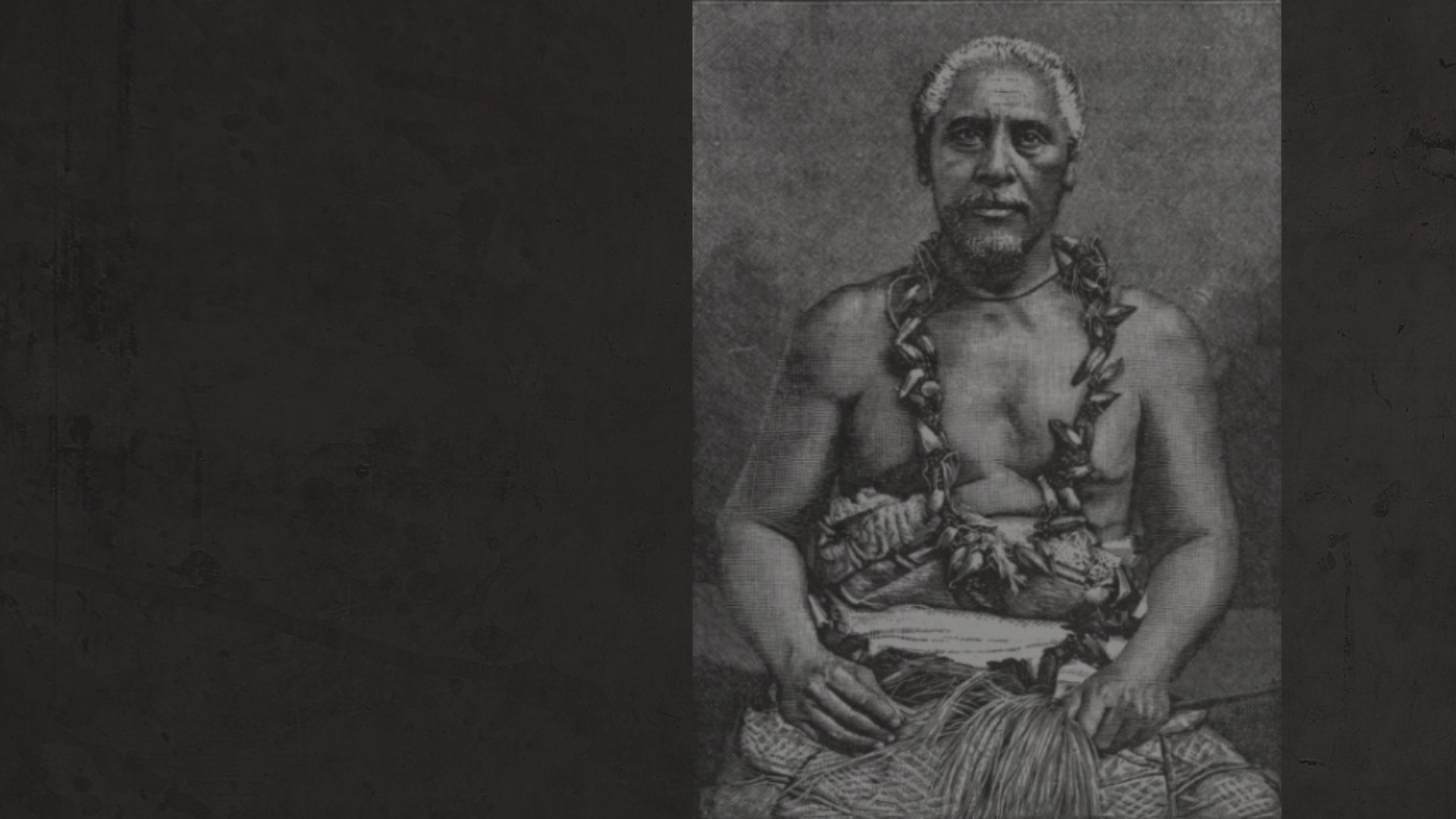
The book includes a plate, 'Mamoe fafine, a Christian Woman'. The plate beside it, 'A Christian Native Chief', is unnamed, but I'm assuming the man is Mamoe.
Stair never itemises what Mamoe and Mamoe fafine contributed.
A miser at his treasures
Unable to return to Samoa, Stair was forced to leave the missionary society, 'to our mutual regret.' The family eventually moved to Australia where he spent more than 37 years as a Church of England clergyman in Victoria. His Samoan records waited. He only had time for 'an occasional loving glance over these old records... hoping that some day they might prove of value.'
He had thought of publishing as early as 1846.
Stair said: '…an occasional loving glance over these old records, as a miser at his treasures'
He went to Australia in 1849, and served in the Dioceses of Melbourne and Ballarat. He resigned as Vicar of St Arnaud in 1893.
The parting of the ways
After retiring in 1893, Stair returned to his Samoan records. Looking back, he realised he had lived through a very interesting time in Samoa. He called it, 'the parting of the ways,' when habits and customs were beginning to change. In 1897 Stair published Old Samoa to 'preserve an accurate picture of them as they were in olden days.'
He admits he didn't grasp the moment while he was living through it: 'the significance of which fact, however, I did not sufficiently realize at the time.'
His reason for publishing in 1897 was 'the present interest in Samoa and Samoan affairs'.
He states his purpose three times in the same preface: 'Such a record will, I trust, prove valuable in after years, as customs change and living witnesses of those changes pass away.'
The generation has passed
Before the book came out, his old friend Samuel Ella, a former Samoan missionary, wrote to him: 'The generation of natives who could have given the required information has passed away, and, with them, the tala-fa'aanamua, the ancient records of the past.' 'Even the Samoan language is changing,' Stair wrote. He could hardly understand a young Malua student 'as he turned all the t's into k's.'
Ella's earlier letter hoped the book would 'enlighten even the present generation of Samoans'.
'Ella's letters are undated. Stair quotes them in his 1897 preface.'
Ella read 'the bulk of my MSS.' before it was printed.
The book gives three different explanations for the loss: the informants dying (Ella), 'new ideas' (Stair), and contact with Europeans (Stair, elsewhere).
What Stair believed about Hawaiki
Stair's belief that Samoa was "the birthplace of much Polynesian settlement" rests on a Rarotongan manuscript and Māori canoe traditions, not on Samoan testimony.
The Rarotongan manuscript was written for him, in Samoa, by a Rarotongan whose ability to write Stair credits to 'the introduction of the Gospel'. Nothing says Stair taught him.
Stair was a London Missionary Society man and dedicated the book to the Society. The Samoa he prized was defined by the absence of the Christianity he came to bring.
The book's introduction is a bishop's foreword for his own clergyman.
The Bishop of Ballarat said the book 'nowise exhausts' what Stair knew: 'I miss from it more than one racy story of old Samoa to which I listened at his table.'
The bishop's comparison: 'The Samoa of Mr. Stevenson was not that of Mr. Stair.'
The end
He died a year after his book was published. A generation passed, and so did a man who worked to preserve what they knew.
This is the second post in our series to discover the scribes of Samoa's history.
These are written records made by a missionary of his time. They are not a substitute for the oral histories held in our families and villages.
Stair never named the two young men from the Camden who became his first printers. Does anyone know who they were?
Sources
John B. Stair, Old Samoa; or, Flotsam and Jetsam from the Pacific Ocean (1897), Preface pp. 13–17; pp. 39, 242, 271–272 287, 290
Richard Lovett, The History of the London Missionary Society 1795–1895, vol. 1 (1899), pp. 375, 384–387
James Sibree, LMS Register of Missionaries (1923), p. 42
George Turner, Nineteen Years in Polynesia (1861), p. 170 (if the London New Testament line stays)
Plate from John B. Stair, Old Samoa (1897), Religious Tract Society. Copy digitised by Google, original from Harvard University, via HathiTrust — public domain.
About the Author

Lilieni
Writer & Builder | Founder, Anavatau
Lillian Arp is a Samoan-born writer and software engineer, and a lifelong student of Samoan language, culture and history. She built the Anavatau Heritage Archive when she got tired of hunting the web for Samoan resources, and publishes under Lilieni, the Samoan form of her first name, because that's what her grandmother called her.
https://anavatau.com